Running an NDIS disability support business is meaningful work and it’s also one of the most admin-heavy environments in Australia. You’re not just delivering supports. You’re managing rosters, shifts, compliance, service agreements, incident processes, plan manager communications, and constant changes across pricing and reporting expectations.
And then there’s the financial side.
Many providers only realise how complex NDIS finances are when something goes wrong: a claim delay, a reconciliation mess, a cash flow crunch, or a compliance concern that creates unnecessary stress. The truth is, NDIS bookkeeping isn’t “normal bookkeeping with a different label”. It has its own pathways, payment structures, and documentation requirements and if your books aren’t set up properly, it can affect everything from payroll confidence to business growth.
That’s why outsourcing bookkeeping isn’t just about saving time. For NDIS providers, it’s about building a system that protects funding accuracy, supports compliance, and keeps cash flow predictable even when your roster is full and your team is stretched.
In many industries, the money pathway is simple: deliver the service, invoice the customer, get paid, reconcile the bank, done.
In NDIS, the payment pathway often involves multiple parties and multiple rules. On the same day, you might be managing NDIA-managed claims through a portal, plan-managed invoices sent to a plan manager, and self-managed invoices paid directly by families. Each pathway has different timing, documentation expectations, and follow-up steps.
You may also be balancing:
Even when you’re providing excellent support, your back-end system can fall behind quickly if it’s not designed for NDIS operations. That’s why many providers focus on building smart financial systems that support long-term NDIS success
Outsourcing can be a huge advantage but only if the bookkeeping function actually understands NDIS realities. Otherwise, you risk paying for someone to “process transactions” without protecting the parts that matter most.
NDIS providers can’t afford books that are only cleaned up at BAS time. Delayed reconciliations create delayed clarity, and delayed clarity leads to decisions made on assumptions.
When reconciliations are completed consistently, you can see what’s been paid, what’s outstanding, and where gaps are forming before they become bigger issues. It also reduces the admin spiral that happens when you’re trying to fix several months of errors in one weekend something many providers experience when they’re already busy delivering supports.
Just as importantly, clean reconciliations make it easier to separate real cash flow problems from timing issues. Sometimes the business is healthy, but the payment cycle is slow. Sometimes the invoicing process needs tightening. You can’t tell the difference until your books are current.
For providers, invoicing is directly linked to cash flow stability. When invoices go out late, when line items don’t match service delivery records, or when follow-ups aren’t structured, you end up funding operations out of your own pocket while waiting for money you’ve already earned.
A good bookkeeping process supports timely invoicing and keeps your receivables visible. That means you can follow up professionally, not emotionally with confidence in the numbers and a clear trail of what was billed and why.
This is one of the biggest reasons NDIS providers choose outsourced bookkeeping services Australia not because they can’t invoice, but because they want a process that stays consistent even when operations get busy, staff change, or leadership is focused on growth.
NDIS businesses often have a mix of labour and non-labour expenses: travel, consumables, software, vehicle costs, training, worker screening, uniforms, clinical supports, and more. If your bookkeeping isn’t categorised consistently, your reporting becomes noisy and you can’t tell what’s actually happening.
Good categorisation supports:
The goal isn’t “perfect accounting language”. The goal is visibility you can use in real conversations, like: “Which service line is growing?” or “Why did costs increase this quarter?” or “Can we afford a team leader in this region?”
For many NDIS providers, payroll is the biggest weekly outgoing. Even a strong business can feel tight if payroll timing and receivables timing aren’t aligned.
A bookkeeping workflow that supports payroll helps ensure your reporting reflects true labour costs per period, not messy numbers that are half roster-based and half guesswork. It also helps you plan ahead. When you can see payroll commitments, upcoming bills, and expected incoming payments clearly, you avoid that “we’re busy but broke” feeling.
This is especially important when you’re growing your team, increasing shifts, or operating across multiple service locations.
NDIS compliance isn’t only about what you do on the floor. It also includes the records behind your billing and payment processes.
While bookkeeping isn’t the same as audit documentation, a strong financial system makes it easier to show:
Providers who keep their books clean and consistent generally experience fewer disputes and smoother internal operations — because everyone can trust the numbers.
When choosing a partner, don’t just ask “Can you do my books?” Ask whether they can support your NDIS operation properly.
Look for a team that offers a steady rhythm weekly or fortnightly processes that keep things current. You also want reporting that’s easy to understand (and explained when needed), plus practical recommendations to improve invoicing flow, expense tracking, and payroll readiness.
This is where outsource bookkeeping solutions become more than a service they become part of your operating system. It’s not about fancy dashboards. It’s about keeping your admin lighter and your decision-making clearer.
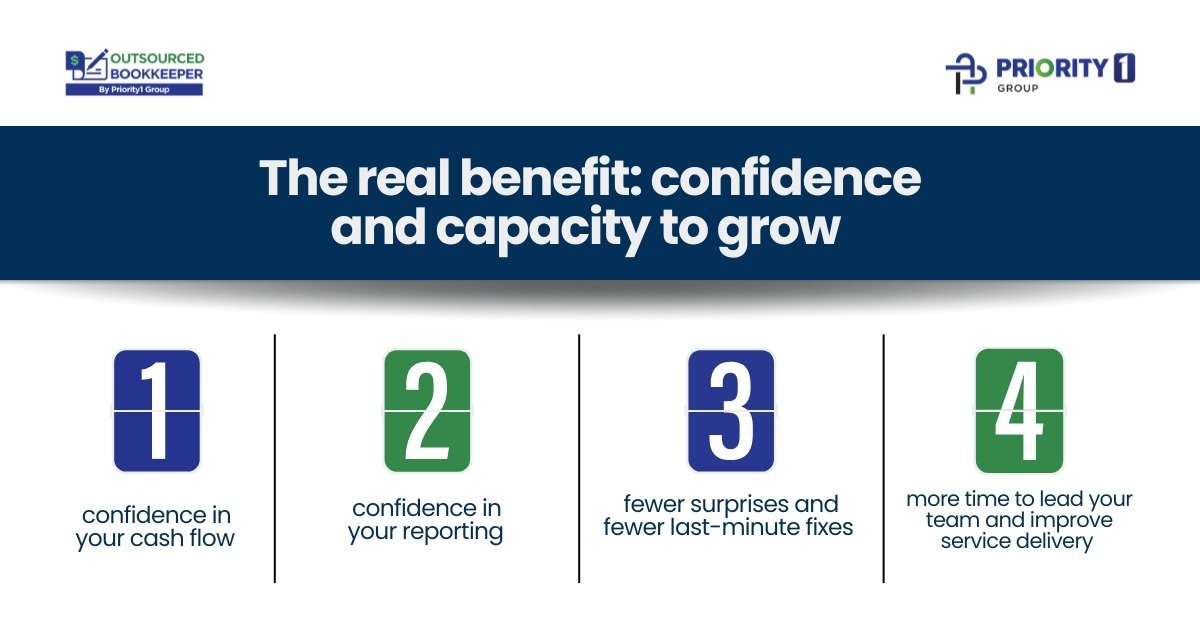
Most NDIS providers don’t struggle because they lack care. They struggle because the admin load grows faster than the team can handle.
When bookkeeping is done well, you get more than compliance:
And that confidence matters when you’re ready to scale — whether that means taking on more participants, expanding locations, hiring team leaders, or strengthening internal systems.
NDIS providers don’t need “basic bookkeeping”. They need a system that supports the way NDIS businesses actually operate with multiple funding types, strict invoicing expectations, heavy payroll demands, and the constant need for accurate reporting.
When outsourcing is done right, bookkeeping becomes a foundation for growth, not just a monthly admin task. You gain clarity, control, and the breathing room to focus on what matters: delivering quality supports and building a sustainable service.
If you’re ready for a bookkeeping partner that understands NDIS workflows and supports your business with reliable systems, Outsourced Bookkeeper by Priority1 Group is here to help.