
When it comes to managing finances, every business, whether small or large, has to make a crucial decision: should they opt for outsourced bookkeeping services or handle their financial operations in-house? Both choices come with their own set of advantages and challenges. But understanding the true cost breakdown of each can help guide the right decision for your business.
In this blog, we will explore the differences between outsourced and in-house bookkeeping, dive into the costs associated with each, and discuss why many businesses are turning to outsourced bookkeepers for a more efficient, cost-effective solution.
Before delving into the costs, let’s take a moment to understand what bookkeeping actually involves. Bookkeeping refers to the day-to-day recording of a business’s financial transactions. It covers tasks such as:
Having accurate and up-to-date financial records is critical for any business to thrive. Whether done in-house or outsourced, the quality of bookkeeping will ultimately affect how well your business is able to manage its finances.
For many businesses, particularly in their early stages, the natural inclination is to hire an in-house bookkeeper. This could be a full-time employee, part-time worker, or even an accounting team, depending on the size and needs of the business. But what are the associated costs of bringing bookkeeping in-house?
The primary cost of in-house bookkeeping is the salary of the bookkeeper(s). According to industry standards, a full-time bookkeeper in Australia typically earns anywhere between $50,000 to $80,000 annually, depending on experience and the complexity of the business’s financial operations.
Additional labor costs include:
For a small business, these labor costs can quickly add up, especially when considering the need for ongoing training and the time it takes for a new hire to get up to speed.
Running an in-house bookkeeping department requires space, resources, and additional infrastructure. Whether it’s purchasing accounting software or maintaining the office equipment, these costs can strain small business budgets. For example, software subscriptions like MYOB, Xero, or QuickBooks can cost anywhere from $50 to $300 per month depending on the features required.
Moreover, having dedicated employees for accounting adds to overhead costs, including office rent, utilities, and general maintenance of a workplace environment.
An in-house bookkeeper is only human, which means errors can occur. Inaccurate data entry or misclassifications may lead to incorrect financial reports, costly mistakes, or even tax penalties. Without the right processes and checks in place, these errors can become expensive to correct.
Outsourcing bookkeeping services is becoming increasingly popular, especially among small and medium-sized businesses looking to streamline operations and reduce costs. But what makes outsourced bookkeeping a viable alternative?
Outsourcing your bookkeeping to a third-party service allows businesses to avoid the high labor costs associated with in-house bookkeeping. Instead of paying a full-time salary, businesses pay a set fee for outsourced bookkeeping services, often on a monthly or quarterly basis.
Moreover, outsourced bookkeeping providers, such as those available in Australia, offer flexibility. Businesses can scale their bookkeeping needs up or down as required, meaning they don’t need to overpay for services they don’t need. For example, a business may require additional bookkeeping support during tax season or the end of a financial year, and outsourced providers can accommodate those needs.
One of the most significant benefits of outsourcing is gaining access to experienced professionals. Outsourced bookkeepers are typically well-versed in the latest accounting software, tax laws, and financial management best practices. This expertise ensures that your finances are handled with accuracy and efficiency.
Additionally, outsourced bookkeepers can often streamline the accounting process, utilizing automation tools and systems that reduce the time spent on manual tasks. The result? Less time spent on routine bookkeeping, leading to increased overall efficiency for the business.
Unlike in-house teams, outsourced bookkeepers provide businesses with flexible, scalable solutions that align with their specific needs. Whether a company needs assistance with payroll, tax filing, or comprehensive financial reports, outsourcing offers tailored packages that suit any business size or budget.
Many outsourced bookkeeping companies also offer specialized services, such as NDIS bookkeeping, healthcare bookkeeping, or real estate accounting. For example, outsourced bookkeeping services are part of Priority1Group, offering tailored solutions for different industries, including NDIS and healthcare, across Australia.
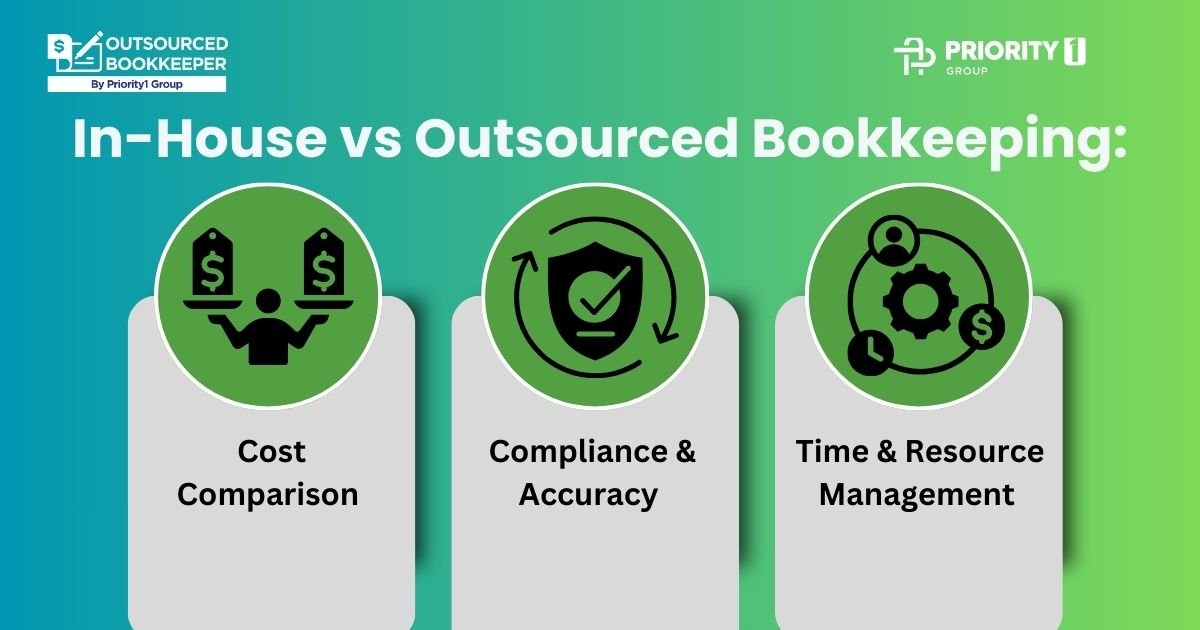
When it comes to cost, outsourcing is often the more budget-friendly option, especially for small businesses. You avoid the upfront costs of software and the ongoing cost of paying an in-house team. However, if your business is large enough, in-house payroll can offer long-term cost savings by eliminating outsourcing fees.
Outsourcing payroll ensures you stay compliant with tax laws and employee regulations, as providers typically specialise in payroll management and keep up with legislation. In-house payroll, on the other hand, requires constant vigilance to remain up-to-date with regulatory changes. In the 2024 Australian Payroll Association survey, 74% of businesses cited compliance as the top reason for outsourcing payroll.
For small businesses, time is a precious commodity. In-house payroll can consume a significant amount of time, especially when handling errors or late payments. Outsourcing allows you to redirect that time into growing your business and servicing your customers, whether you are in the healthcare or real estate industry.
Let’s break down the financial implications of both in-house and outsourced bookkeeping, taking into account various expenses and overheads.
Total: $54,600 – $98,600 annually
Total: $6,000 – $24,000 annually
As you can see, the costs of outsourcing bookkeeping services are significantly lower than maintaining an in-house team, especially when considering long-term overhead and operational expenses.
While cost is a major factor, it’s not the only consideration when choosing between in-house and outsourced bookkeeping.
Outsourcing your bookkeeping tasks frees up your time and allows you to focus on what you do best—growing your business. The time spent managing an in-house team, coordinating meetings, and dealing with bookkeeping-related issues can be redirected toward strategic initiatives that drive your business forward.
Outsourcing to professional bookkeepers significantly reduces the risk of financial errors. These professionals are equipped with the knowledge and resources to ensure compliance with tax laws and financial regulations, helping businesses avoid costly penalties.
The decision between outsourced bookkeeping and in-house bookkeeping largely depends on the specific needs of your business, your budget, and the complexity of your financial operations.
For many businesses, especially those looking to cut costs, reduce errors, and streamline their financial management, outsourced bookkeeping services offer a more practical, efficient solution. With access to expert bookkeepers and scalable services, outsourcing enables businesses to operate more smoothly without the added burden of managing an in-house team.
If you’re looking for reliable, cost-effective outsourced bookkeeping services across Australia, Priority1Group offers tailored bookkeeping solutions to businesses nationwide. As part of their outsourced bookkeeping services, businesses can focus on growth while Priority1Group ensures financial records are managed with precision and expertise.
Ultimately, outsourcing your bookkeeping services can offer your business the flexibility, savings, and expertise needed to thrive in today’s competitive market.