

In today’s fast-paced business world, many companies are looking to streamline their operations, reduce costs, and enhance their focus on core activities. One of the most effective ways to achieve this is by outsourcing non-core functions such as bookkeeping. But what exactly does an outsourced bookkeeper do, and what do they not? In this article, we will break down the core duties and boundaries of outsourced bookkeeping services, particularly for industries like NDIS (National Disability Insurance Scheme) providers, and why partnering with a professional service can make a significant difference for your business.
Outsourced bookkeeping refers to the practice of hiring an external professional or team to handle all or some of a company’s financial tasks. These tasks can range from basic data entry and account reconciliation to more complex services like financial reporting, tax preparation, and compliance management. By outsourcing bookkeeping, companies, especially those in sectors such as NDIS, can focus on providing high-quality services to their clients without being bogged down by the intricacies of financial management.
At the heart of bookkeeping is the accurate recording and maintenance of financial transactions. An outsourced bookkeeper ensures that all financial data is entered into your accounting system, whether that’s Xero, MYOB, QuickBooks, or another platform. They’ll capture daily transactions such as sales, expenses, and purchases and make sure they are correctly recorded under the appropriate categories.
Bank reconciliation is a crucial task that ensures your records match your bank statements. An outsourced bookkeeper will regularly review bank statements, credit card statements, and other financial records to identify discrepancies, ensuring everything aligns. This prevents errors and gives you peace of mind that your financial data is up-to-date and accurate.
Another critical responsibility of an outsourced bookkeeper is to provide regular financial reports. These reports include profit and loss statements, balance sheets, and cash flow statements. They help you understand the financial health of your business and identify areas where you can improve.
For NDIS providers, these reports are especially important as they help track funding, spending, and compliance with the NDIS pricing arrangements. Accurate financial reporting ensures that providers remain audit-ready and transparent in their operations.
For many businesses, the end of the financial year brings a lot of stress, especially when it comes to tax preparation. An outsourced bookkeeper can help manage the preparation of your tax filings, ensuring all your records are for submission to the Australian Taxation Office (ATO).
In addition to year-end tax filing, outsourced bookkeepers also manage BAS (Business Activity Statement) lodgements, ensuring your business remains compliant with GST (Goods and Services Tax), PAYG (Pay As You Go), and other tax obligations. They’ll ensure timely submission and help you avoid penalties or interest on late payments.
Managing payroll is a time-consuming and often complicated task, particularly for businesses with a large workforce. Outsourced bookkeepers help streamline payroll by calculating wages, deductions, superannuation, and other benefits. For NDIS providers, payroll management is crucial due to the complexity of the sector, which involves multiple employees, varying pay rates, and different support needs.
By outsourcing payroll to a professional bookkeeper, you eliminate the risk of errors, compliance violations, and delays. Your team gets paid on time, and your business avoids costly penalties.
In industries like NDIS, compliance is a major concern. Outsourced bookkeepers are familiar with the various compliance requirements specific to industries such as healthcare and disability services. They can help ensure that your financial operations comply with local regulations, such as the NDIS Practice Standards and the NDIS Pricing Arrangements.
An outsourced bookkeeper providing outsourced bookkeeping services also assists in maintaining your records in line with industry standards, making it easier for you to undergo audits and assessments without any hiccups.
They also plays a key role in invoicing and managing accounts payable. They will create invoices for clients, track payments, and follow up on outstanding amounts. This ensures your business has consistent cash flow and that outstanding payments are collected promptly.
For NDIS providers, managing invoicing and accounts receivable accurately is vital, as any delays or discrepancies can affect cash flow and compliance with NDIS funding agreements.
If you’re considering outsourcing your bookkeeping, it’s important to understand the full benefits and how the process works. This guide will help you gain insights into how outsourcing can transform your business operations and improve financial management.
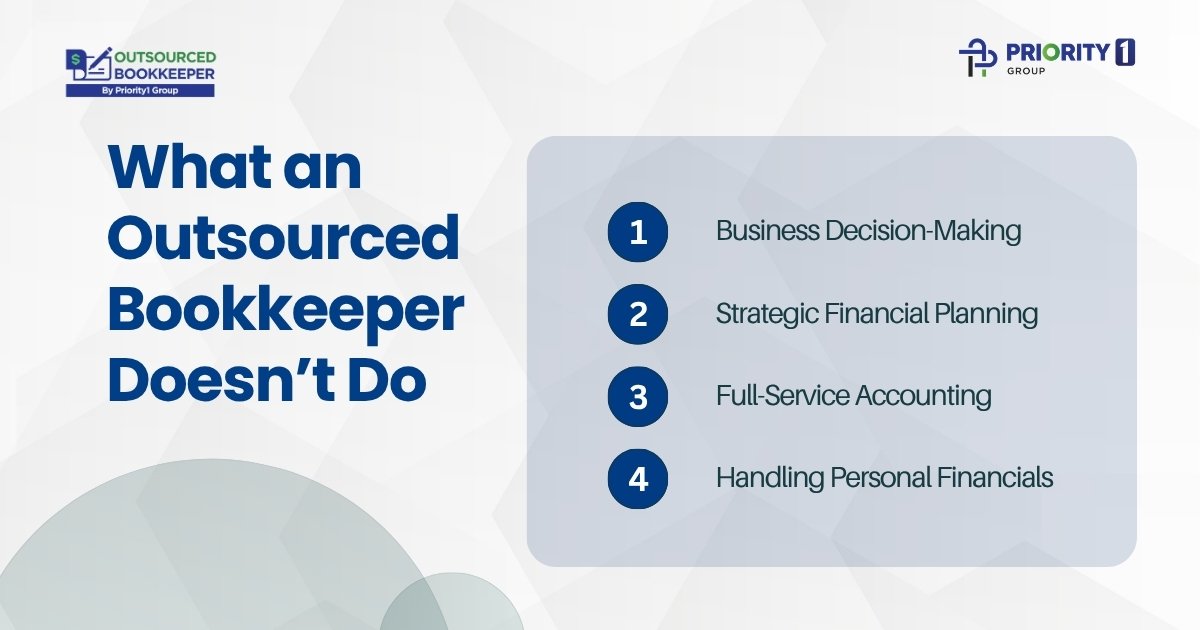
While outsourced bookkeepers can handle a wide variety of financial tasks, there are some areas where their responsibilities typically don’t extend. Here’s what an outsourced bookkeeper won’t do:
Outsourced bookkeepers provide the financial data and analysis you need to make informed decisions, but they do not make decisions on behalf of your business. The decision to expand, invest, or pivot your business direction is yours to make. Bookkeepers simply provide the necessary financial insight to help you make those decisions wisely.
While outsourced bookkeepers can help you analyse financial reports, the role of creating long-term financial strategies, such as budgeting, forecasting, and investment planning, usually falls to business owners or financial advisors. Outsourced bookkeepers help set the foundation, but it’s up to the business leadership to develop the broader financial strategy.
Bookkeeping and accounting are often confused, but they are distinct functions. Bookkeepers manage the day-to-day financial tasks, while accountants typically handle more complex financial management, such as tax filings and audits. An outsourced bookkeeper is not a substitute for a professional accountant, especially when it comes to preparing comprehensive tax returns, performing audits, or offering high-level financial advice.
Outsourced bookkeepers handle business finances, but they do not manage personal finances unless they are explicitly contracted to do so. The scope of work is strictly business-related, and personal financial planning, like managing personal tax returns or retirement planning, typically falls outside their responsibilities.
Partnering with an outsourced bookkeeper offers many benefits, especially for NDIS providers looking to focus on growing their businesses and delivering quality care. Here’s why outsourcing your bookkeeping is a smart move:
Hiring a full-time in-house bookkeeper can be costly, particularly for small to medium-sized businesses. By outsourcing, you can access professional bookkeeping services at a fraction of the cost. You pay for only the services you need, with no overhead costs associated with hiring, training, and maintaining an in-house team.
Managing finances for NDIS providers requires specialised knowledge, particularly when it comes to compliance with NDIS pricing arrangements, participant funding, and service delivery. A professional NDIS bookkeeper is well-versed in these requirements and can help ensure your financial systems remain compliant and efficient.
As your business grows, so do your financial needs. Outsourced bookkeeping services are scalable, meaning they can grow with your business. Whether you need additional reporting, more detailed financial analysis, or expanded payroll services, an outsourced bookkeeper can adapt to meet your evolving needs.
By outsourcing your bookkeeping, you free up time and resources to focus on what really matters, providing care to your clients and growing your business. You don’t have to worry about financial data management, compliance, or system inefficiencies.
For NDIS providers, it’s essential to have financial systems that are tailored to the unique needs of the sector. Learn how these systems can ensure long-term success and sustainability for your business.
Outsourcing your bookkeeping functions can provide tremendous value for your business, especially in highly regulated sectors like NDIS. Partnering with a professional outsourced bookkeeper by Priority1 Group ensures that your financial management is handled accurately and efficiently, while you stay focused on delivering high-quality services to your participants.
By outsourcing your bookkeeping, you gain peace of mind knowing your financial records are in order, your business is compliant, and you have the right support to grow. Whether you’re a small NDIS provider or a larger organisation, outsourced bookkeeping is a practical, cost-effective solution that can help you streamline your operations and focus on what you do best.