
When businesses think about growth, they often focus on increasing sales, hiring new staff, expanding services, or entering new markets. However, one area that frequently receives less attention is payroll management.
Payroll is one of the few business functions that directly affects every employee. Staff expect to be paid accurately and on time, regardless of how busy the organisation becomes. At the same time, employers must manage tax obligations, superannuation, leave entitlements, reporting requirements, and compliance responsibilities.
For small businesses, payroll may initially seem straightforward. However, as workforce numbers increase, payroll becomes significantly more complex. What starts as a simple payment process can quickly evolve into a critical operational function that requires strong systems, accurate reporting, and ongoing compliance oversight.
Businesses that fail to adapt their payroll processes as they grow often experience administrative pressure, compliance risks, and workforce dissatisfaction. On the other hand, organisations that establish reliable payroll systems create stronger foundations for long-term growth and workforce stability.
Payroll mistakes are often viewed as minor administrative issues, but their impact can extend far beyond a single pay cycle.
An incorrect wage calculation missed superannuation payment, or inaccurate leave balance can create frustration for employees and additional workload for management teams. Repeated payroll issues can also affect workplace morale and damage trust within the organisation.
Some of the most common payroll errors include:
These issues consume valuable time and resources because they often require investigation, correction, and communication with employees.
More importantly, payroll errors can create reputational risks and undermine confidence in the organisation’s ability to manage its workforce effectively.
Many operational inefficiencies remain hidden from employees, but payroll issues are different. Staff members notice immediately when something is wrong with their pay.
Whether it is an incorrect hourly rate, missing allowance, or delayed payment, payroll mistakes directly affect employee confidence and workplace satisfaction.
Employees generally expect:
When these expectations are consistently met, trust within the workforce strengthens. When they are not, businesses often experience increased payroll enquiries, employee frustration, and reduced engagement.
This is why payroll should be viewed as a workforce management function rather than simply an administrative process.
As organisations grow, managing employee entitlements becomes increasingly challenging.
Annual leave, personal leave, overtime, public holidays, allowances, and other workforce-related payments all require accurate tracking and administration. Errors in these areas can quickly create compliance concerns and employee disputes.
Growing businesses often struggle with:
Without structured payroll systems, these responsibilities become increasingly difficult to manage.
Businesses that invest in stronger payroll processes are often better equipped to handle workforce growth while maintaining accuracy and compliance.
Payroll compliance extends beyond paying employees correctly. Businesses must also meet a range of reporting and regulatory obligations.
Failure to maintain accurate payroll records can result in:
To reduce risk, businesses should focus on:
Strong payroll governance helps businesses remain prepared for audits and compliance reviews while reducing operational risk.
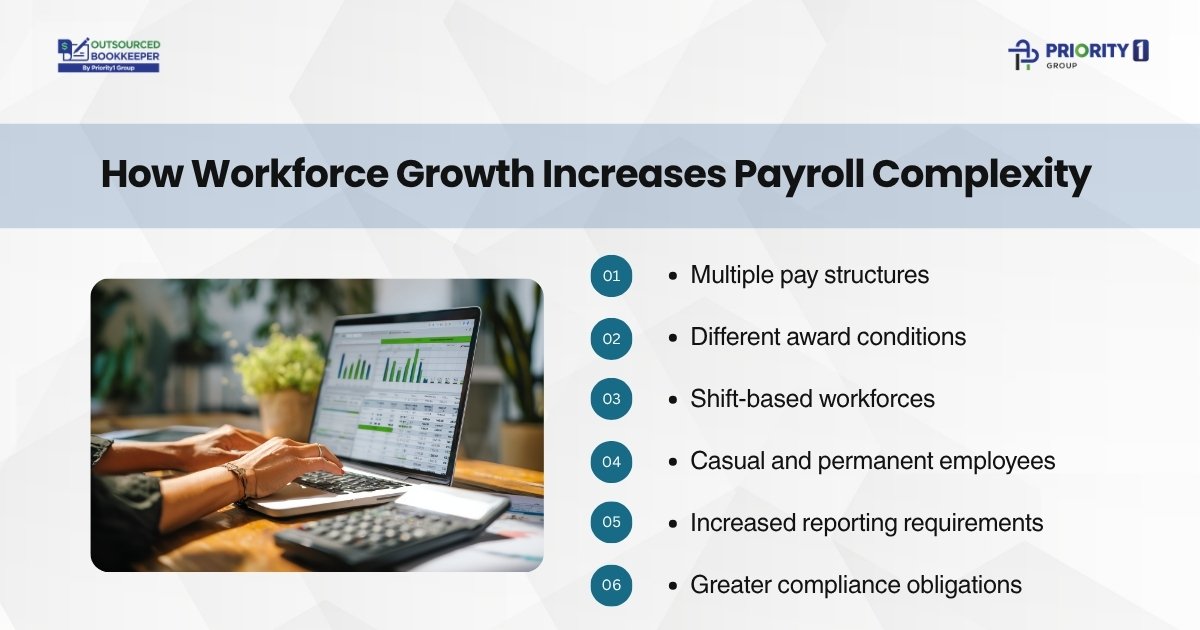
Every new employee adds another layer of payroll administration.
As businesses grow, payroll teams must manage additional employee records, pay structures, leave balances, and reporting requirements. Workforce diversity also introduces different employment arrangements that may require specific payroll treatment.
Growing organisations often encounter:
This growing complexity is one reason many businesses begin exploring payroll outsourcing Australia solutions as workforce numbers increase.
By creating more structured payroll systems, businesses can reduce administrative pressure while maintaining consistency and accuracy.
Payroll is often one of the largest expenses within an organisation. Understanding workforce costs is therefore critical for budgeting, forecasting, and strategic planning.
Accurate payroll information helps businesses:
This is where payroll and bookkeeping become closely connected.
Many organisations use outsourced bookkeeping services to improve financial reporting while ensuring payroll information remains accurate and aligned with broader business objectives.
Businesses that integrate payroll management with strong financial systems are often better positioned to make informed decisions and maintain operational stability.
For organisations considering a broader outsourcing strategy, the article The 2026 Definitive Guide to Outsourcing Your Bookkeeping provides valuable insight into how outsourcing can improve efficiency, scalability, and financial control.
The disability services industry presents unique payroll challenges due to its workforce structure and compliance requirements.
Providers often manage:
Managing these responsibilities accurately requires strong payroll systems and detailed financial oversight.
This is why many providers work with specialised support such as NDIS Bookkeeper services that understand the operational and financial requirements of disability service organisations.
Strong financial management is also essential for balancing participant outcomes with long-term sustainability. Providers looking to strengthen their financial systems can gain valuable insights from the article on NDIS accounting and balancing service delivery with financial health.
Payroll issues rarely appear overnight. In most businesses, warning signs emerge gradually as operational demands increase.
Some indicators that payroll systems may require attention include:
Addressing these issues early can prevent larger operational problems and reduce future administrative burden.
Businesses that regularly review payroll processes are often better positioned to maintain workforce confidence and operational efficiency.
The most effective payroll systems are designed to support business growth rather than simply process employee payments.
Strong payroll frameworks typically include:
These systems help businesses maintain consistency while adapting to changing workforce requirements.
Most importantly, they create confidence among employees, management teams, and business owners by ensuring payroll processes remain accurate, organised, and reliable.
Payroll management is far more than a back-office function. It influences employee trust, compliance outcomes, workforce planning, financial management, and operational stability.
As businesses continue to grow, payroll responsibilities become increasingly complex. Organisations that invest in strong payroll systems are often better positioned to maintain compliance, support workforce satisfaction, and reduce operational risk.
By creating reliable payroll processes and integrating them with broader financial management systems, businesses can build stronger foundations for sustainable growth.
For businesses seeking greater payroll accuracy, workforce efficiency, and financial control, Outsourced Bookkeeper by Priority1 Group provides tailored bookkeeping and payroll support designed to help organisations manage growth with confidence.