
Every successful business relies on more than sales and operations alone. Behind stable growth and smooth day-to-day management is a financial system that keeps everything organised, accurate, and compliant. Yet many businesses still struggle with bookkeeping processes that are inconsistent, delayed, or difficult to manage as operations grow.
What starts as a manageable task in the early stages of a business often becomes more complicated over time. Payroll expands, supplier payments increase, reporting obligations become more demanding, and financial records become harder to track manually. Business owners and managers then find themselves spending more time handling administrative work instead of focusing on customers, operations, and growth.
Modern bookkeeping is no longer just about recording transactions. It plays an important role in financial planning, operational visibility, compliance management, and business decision-making. Businesses that maintain organised financial systems are often better positioned to respond to challenges early, identify opportunities faster, and operate with greater confidence.
This growing need for financial clarity is why many Australian businesses are now looking for smarter and more scalable financial support solutions.
Many operational problems begin with poor financial visibility. When business owners do not have accurate or up-to-date financial information, decision-making becomes stressful and reactive. Uncertainty around expenses, cash flow, payroll, or profitability can quickly affect the stability of the business.
Reliable bookkeeping systems create structure and clarity. Instead of constantly trying to fix financial issues after they occur, businesses are able to monitor performance more consistently and make informed decisions based on accurate reporting.
Strong bookkeeping support helps businesses maintain better control over:
When financial systems are organised properly, businesses spend less time chasing paperwork and correcting errors. This creates more time for operational planning, customer service, and long-term strategy.
Accurate bookkeeping also reduces the risk of duplicated transactions, payroll discrepancies, missed expenses, or delayed reporting that can gradually create larger operational problems.
This is why many businesses are now choosing to work with an outsourced bookkeepers to improve consistency, operational efficiency, and financial stability.
As businesses grow, financial administration becomes more demanding. More staff, larger payrolls, increasing transaction volumes, and ongoing reporting obligations place additional pressure on internal teams.
Many businesses initially attempt to manage bookkeeping internally, but over time this often creates bottlenecks. Managers become overloaded with administrative work, reporting delays begin to occur, and financial processes lose consistency.
This has led many Australian businesses to adopt more flexible financial support models that provide experienced bookkeeping assistance without the need for large in-house finance departments.
Businesses that implement structured bookkeeping support often experience improvements in:
Cloud accounting systems such as Xero, MYOB, and QuickBooks have also changed the way businesses manage finances. Real-time reporting and automation tools now allow businesses to access financial information more efficiently and improve collaboration between teams.
However, technology alone is not enough. Businesses still require knowledgeable professionals who understand reconciliations, compliance obligations, payroll management, and reporting accuracy.
This combination of financial expertise and technology is becoming increasingly valuable for businesses seeking long-term operational stability.
For businesses wanting to better understand how structured financial systems improve operational performance, this article on Outsourced Bookkeeping Services That Support Cash Flow and Growth explains how stronger bookkeeping processes contribute to financial clarity and sustainable growth.
Business growth often brings new opportunities, but it can also expose weaknesses in financial systems. As operations expand, even small bookkeeping inconsistencies can gradually create larger operational and compliance problems.
Businesses experiencing growth commonly face challenges such as:
Without organised financial systems, these issues can affect profitability, operational efficiency, and decision-making.
Strong bookkeeping systems create structure during periods of growth. Businesses gain clearer visibility over revenue, expenses, payroll obligations, and financial performance, allowing them to make more confident operational decisions.
Reliable financial reporting also helps businesses identify inefficiencies early. Understanding where money is being spent and how operations are performing financially allows business owners to improve budgeting and reduce unnecessary costs before they become larger issues.
Most importantly, organised bookkeeping systems reduce stress across the business. Management teams can focus more on operations and planning because they know financial records are accurate, accessible, and consistently maintained.
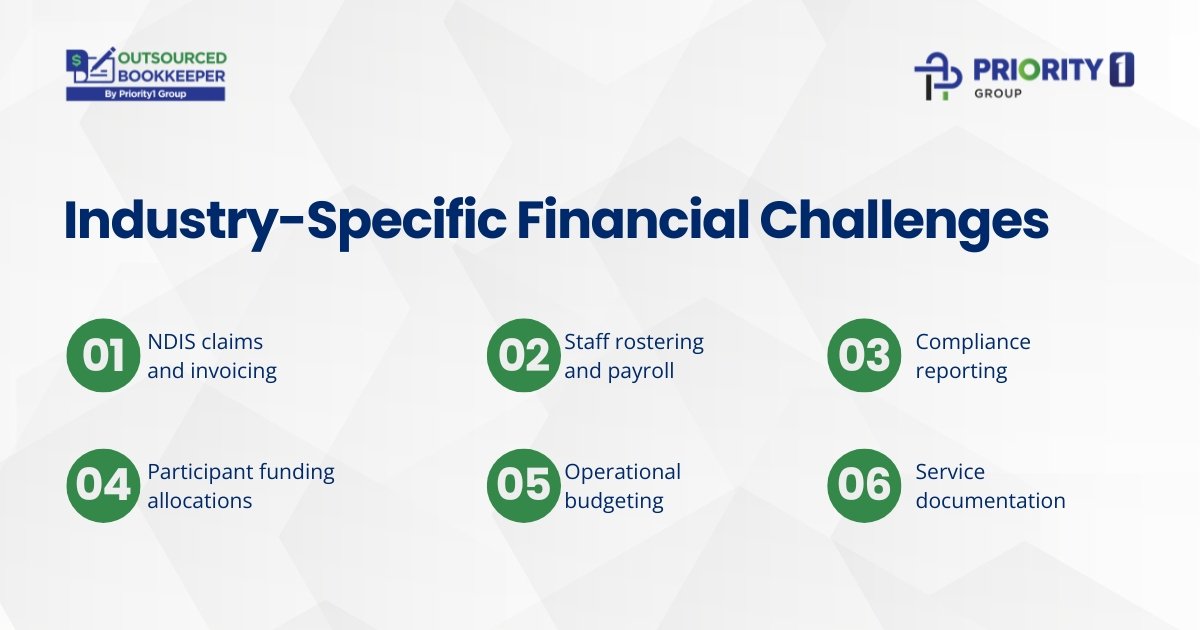
Every industry has unique financial pressures. Businesses operating in healthcare, retail, hospitality, trades, and disability services often require more specialised bookkeeping support because of industry-specific operational and compliance requirements.
The disability services sector operates within a highly regulated funding environment where financial management directly impacts participant services, compliance outcomes, payroll accuracy, and operational continuity.
Providers often manage:
Managing these responsibilities consistently requires structured financial systems and a strong understanding of industry requirements.
This is why many providers rely on specialised support such as NDIS Bookkeeper services that understand the operational and compliance challenges within the NDIS sector.
For providers wanting a clearer understanding of how financial management supports participant continuity and operational sustainability, this article on the Financial Lifecycle of NDIS Services explains the relationship between bookkeeping, compliance, payroll management, and long-term service delivery.
Financial inefficiencies rarely appear overnight. In many businesses, problems develop gradually and become noticeable only after operational pressure increases.
One of the most common warning signs is delayed reporting. When financial reports are consistently late, business owners lose visibility over business performance and cash flow. This makes planning and decision-making significantly more difficult.
Payroll inconsistencies are another indicator that bookkeeping systems may require improvement. Errors in wages, missed entitlements, or incomplete records can create unnecessary operational and compliance risks.
Businesses may also struggle with poor expense tracking, making it difficult to understand profitability accurately or identify areas where operational costs can be improved.
Growing administrative pressure is another common issue. When managers spend excessive time following up invoices, correcting records, or resolving financial discrepancies, productivity across the business often declines.
Recognising these warning signs early allows businesses to strengthen systems before inefficiencies begin affecting growth, compliance, or operational stability.
Technology has transformed bookkeeping significantly over the past decade. Cloud-based accounting platforms now allow businesses to access real-time financial information from almost anywhere, improving both visibility and operational efficiency.
Modern bookkeeping systems support:
Cloud accounting platforms also reduce reliance on manual spreadsheets and fragmented reporting systems, helping businesses maintain more accurate and organised financial records.
At the same time, technology still requires experienced professionals who understand financial reporting, reconciliations, compliance obligations, and operational processes. Software can improve efficiency, but strong financial oversight remains essential for long-term business stability.
This is one reason many growing businesses are adopting outsourced bookkeeping Australia solutions that combine modern technology with experienced bookkeeping expertise.
Many businesses focus heavily on completing bookkeeping tasks quickly, but consistency is often more important than speed. Financial systems become unreliable when reporting is rushed, incomplete, or handled differently each time.
Consistent bookkeeping creates stronger operational foundations and helps businesses maintain stability as they grow.
Reliable systems support:
Businesses that maintain organised and consistent bookkeeping processes are generally better prepared for operational challenges because financial information remains accessible, accurate, and reliable when it is needed most.
Consistency also builds confidence across the business. Management teams can rely on financial reports, payroll processes remain organised, and operational planning becomes far more effective.
Businesses that view bookkeeping as a core operational function rather than a basic administrative task are often better positioned for sustainable long-term growth.
Bookkeeping has evolved far beyond basic data entry. Today, it plays a central role in helping businesses maintain operational efficiency, financial clarity, compliance, and long-term stability.
As businesses continue to grow and financial responsibilities become more demanding, organised bookkeeping systems are becoming increasingly important. Accurate financial management helps businesses improve visibility, reduce operational pressure, strengthen compliance processes, and make more informed decisions with confidence.
Businesses that invest in structured financial systems are often able to operate more efficiently because they have access to reliable financial information that supports both day-to-day management and long-term planning.
For businesses looking to improve financial organisation and operational consistency, Outsourced Bookkeeper byPriority1 Group provides tailored bookkeeping support designed to help Australian businesses build stronger financial systems while staying focused on sustainable growth.