For many NDIS providers, 1st July is more than the start of a new financial year. It is also a time when pricing updates, payroll checks, service agreements, invoicing processes, and internal records may all need attention. Even small changes to price limits or claiming rules can create extra pressure if the bookkeeping system is not prepared.
This matters because NDIS providers already operate in a detailed environment. Providers are not only delivering supports; they are also managing rosters, staff wages, participant budgets, service bookings, invoices, claims, reports, receipts, and compliance records. When pricing updates come into effect, those records need to match the latest information as closely as possible.
For small and growing providers, this can feel overwhelming. A provider may have good intentions, a committed team, and strong participant relationships, but still struggle with financial admin behind the scenes. If invoices are raised using old rates, if payroll is not checked against shifts, or if reports are not reviewed regularly, the business can lose clarity very quickly.
That is why bookkeeping should not be treated as a task that only matters at tax time. For NDIS providers, bookkeeping supports day-to-day decisions. It helps providers understand whether services are being billed correctly, whether staff costs are sustainable, whether cash flow is strong enough, and whether records are ready if questions are asked later.
The 1st July pricing update period is a useful reminder to pause and review the systems that support your business. It is not only about changing numbers in your software. It is about making sure your invoicing, payroll, reporting, and document management all work together.
NDIS pricing updates can affect providers in practical ways. A price change may seem simple on paper, but it can move through the business in several directions. It may affect how services are quoted, how invoices are raised, how participant agreements are reviewed, and how income is reported.
For example, if a provider continues using an outdated price for a support item, invoices may be incorrect. If the issue is not noticed quickly, it can create follow-up work, delayed payments, adjustments, or confusion for the participant, plan manager, or accounts team. When this happens across multiple participants or service types, the admin load increases.
There is also a cash flow impact. Many NDIS providers operate with regular wage costs, rent, software subscriptions, insurance, vehicles, and other operating expenses. If invoicing is delayed while the team checks updated rates, or if claims need to be corrected, cash flow may become harder to predict. Even when money eventually comes in, the delay can make payroll and supplier payments more stressful.
Pricing updates can also expose gaps in internal communication. The operations team may know which services were delivered, the rostering team may know who worked the shift, and the accounts team may be responsible for invoicing. If these areas are not aligned, the provider may struggle to confirm what should be billed and at what rate.
This is especially important for growing providers. A small provider may be able to manually check invoices when there are only a few participants. But as the business grows, manual systems become more fragile. More participants, more staff, more service categories, and more invoices mean there is less room for inconsistent processes.
Good bookkeeping does not remove every challenge, but it does create structure. When records are current, pricing tables are updated, documents are stored properly, and reports are reviewed, providers can respond to changes with more confidence.
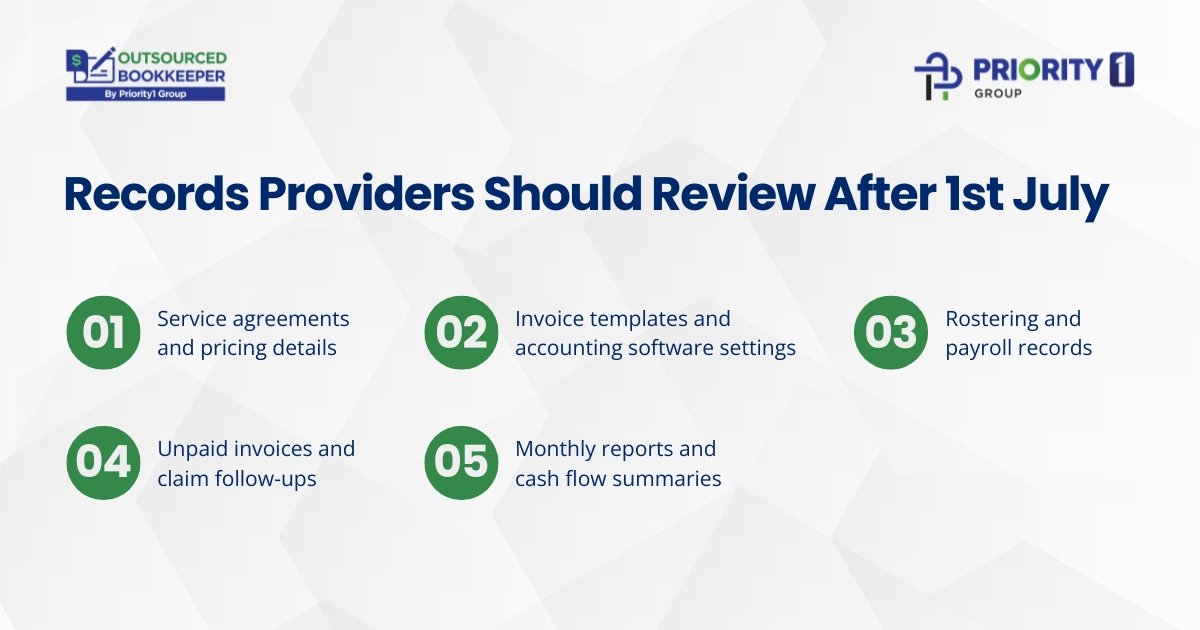
After pricing updates come into effect, providers should not rely on memory or assumptions. A clear review process can reduce errors and help the business stay organised. The aim is to check the records that directly affect invoicing, income, payroll, and reporting.
Key areas to review include:
These checks may sound simple, but they are often missed when teams are busy. In many businesses, bookkeeping is handled in between participant support, staff questions, urgent rostering issues, and general admin. This is where remote support can be useful.
Modern bookkeeping has also changed significantly. Cloud-based systems, secure document storage, and online reporting tools can make it easier for providers to keep information updated without needing a full-time person sitting in the office. You can read more about this in this guide on how technology is transforming modern bookkeeping.
For providers that want structured support without hiring internally, working with an outsourced bookkeeper can help reduce the daily admin burden while keeping financial records clearer and more consistent. This is particularly valuable when pricing updates, payroll checks, BAS preparation, and reporting deadlines all happen around the same time.
Invoicing is one of the most important areas affected by pricing updates. For NDIS providers, invoicing is not just about sending a bill. It needs to reflect the right participant, the right service, the right date, the right support category, the right rate, and the right supporting information.
When invoicing is accurate, payments are usually easier to track. When invoicing is unclear or inconsistent, follow-up work increases. Plan managers may request clarification, participants may question charges, and internal teams may need to review rosters or service notes again. This can slow down cash flow and increase pressure on the accounts process.
Better bookkeeping helps by creating a routine. Instead of waiting until the end of the month, providers can review invoices weekly, match payments regularly, and identify issues before they become larger problems. This also makes reporting more reliable because income and unpaid amounts are easier to understand.
Cash flow visibility is especially important during periods of change. If price updates affect certain services, providers need to know whether their income is still covering wages and operating costs. A monthly profit and loss report can show whether revenue is moving in the right direction, but only if the underlying bookkeeping is accurate.
This is where many providers start to see the value of outsourced bookkeeping Australia support. It is not only about data entry. It is about having a consistent process for invoices, receipts, reconciliations, payroll checks, and reports so business owners are not left guessing.
Providers should also pay attention to clean record keeping. If a payment is received but not matched correctly, or if a receipt is missing, the financial picture becomes less reliable. Over time, small gaps can make BAS preparation, accountant reviews, internal reporting, and audit-related checks more difficult.
For NDIS-specific record keeping, this related article on how clean financial records help NDIS providers explains why organised records matter for provider confidence and accountability. Providers who need more focused support in this area may also benefit from resources created for NDIS Bookkeeper, especially where claims, payroll, and compliance records need closer attention.
Many small NDIS providers start by managing bookkeeping themselves or assigning it to an internal admin person. This can work for a while. But as the business grows, financial admin often becomes too important and too time-consuming to handle casually.
The challenge is that hiring an in-house bookkeeper is not always realistic. A provider may not have enough work for a full-time role, or the cost may be difficult to justify. At the same time, relying on the business owner or service manager to handle financial admin can create stress and increase the risk of delays.
Outsourcing can offer a middle ground. It gives the business access to bookkeeping support without the commitment of employing someone internally. It can also provide more flexibility as the provider grows. The level of support can be adjusted depending on transaction volume, payroll needs, reporting requirements, and business complexity.
For NDIS providers, outsourcing can be helpful when the work is clearly structured. The provider still needs to maintain strong internal communication, but the bookkeeping team can support the financial side of the process.
Outsourced support can assist with:
This does not mean the provider loses control. In fact, good outsourcing should give business owners more visibility, not less. The owner should still receive reports, understand key numbers, and know what is happening financially. The difference is that they are not carrying every bookkeeping task themselves.
For growing providers, this can create breathing room. Instead of spending evenings checking invoices or searching for receipts, owners can focus on service quality, staff support, participant relationships, and business planning.
The best time to improve bookkeeping is before there is a major issue. Providers do not need to wait until invoices are delayed, BAS is stressful, or reports are confusing. A pricing update period is a good opportunity to review the system and make practical improvements.
Start with the basics. Are invoices being raised on time? Are payments being matched correctly? Are payroll records checked before processing? Are receipts and supplier bills saved in one secure location? Are monthly reports reviewed by someone who understands the business?
If the answer to any of these questions is unclear, the bookkeeping process may need attention. The goal is not perfection. The goal is consistency. When the same process is followed each week and month, the business becomes easier to manage.
It also helps to assign responsibility. One person or team should know who checks pricing updates, who updates invoice templates, who follows up unpaid invoices, who prepares payroll information, and who reviews reports. Without clear responsibility, important tasks can be missed.
Bookkeeping also needs to connect with operations. In NDIS businesses, financial records depend on what happens in service delivery. If a shift changes, a participant cancels, a worker claims overtime, or a support category changes, the accounts team needs accurate information. This is why communication between operations and bookkeeping is so important.
Providers should also avoid relying only on end-of-month clean-up. Waiting too long can make errors harder to trace. Weekly checks are often more useful because they keep the business closer to the source of the information.
The 1 July period can also overlap with broader financial year responsibilities. While pricing updates are important, providers must also keep up with BAS preparation, payroll obligations, super records, supplier payments, and accountant requests.
A good bookkeeping process makes these tasks easier. When transactions are reconciled regularly, BAS information is more reliable. When payroll records are checked, wage costs are easier to understand. When reports are reviewed each month, business owners can see whether the provider is growing sustainably.
Reporting should not be treated as a document that is only useful for the accountant. Monthly reports can help providers answer practical questions. Is the business collecting payments quickly enough? Are wage costs increasing faster than income? Are certain services becoming less profitable? Are admin costs rising? Is cash flow strong enough to support the next stage of growth?
These questions matter because providers need financial clarity to make better decisions. Without accurate reports, growth can feel uncertain. With clear reports, owners can plan with more confidence.
Bookkeeping is also useful for audit-related record keeping. While every provider’s circumstances are different, organised financial records can make it easier to respond when documents are requested. Clean records show that the business has a process, not just scattered paperwork.
NDIS pricing updates can create pressure for providers, but they also create an opportunity to strengthen bookkeeping systems. When rates, invoices, payroll records, service agreements, and reports are reviewed properly, providers are better placed to manage cash flow and reduce avoidable admin stress.
For small and growing providers, the goal is not to make bookkeeping complicated. The goal is to make it consistent, accurate, and easier to follow. Remote bookkeeping support can help providers stay organised without the cost and commitment of hiring a full-time in-house bookkeeper.
A strong bookkeeping process supports more than compliance. It helps owners understand their numbers, manage cash flow, prepare for BAS, check payroll, and make better decisions as the business grows.
If your provider business is entering a new pricing period with unclear records, delayed invoices, or reporting pressure, now is a good time to review the process and put better support in place with Outsourced Bookkeeping by Priority1 Group.