As NDIS providers grow, bookkeeping becomes more than recording numbers. It directly affects cash flow, payroll accuracy, compliance, reporting, and the provider’s ability to deliver consistent support to participants. Choosing the right bookkeeping model is therefore an important business decision.
Many providers compare domestic bookkeeping with offshore bookkeeping. Domestic bookkeeping offers local understanding and easier communication, while offshore bookkeeping can provide cost efficiency and scalability. However, the most practical solution is often not one or the other. The better approach is finding a middle ground that combines local expertise with structured offshore support.
Domestic bookkeeping means working with an in-house team or an Australian-based bookkeeping provider. This model is often valued because local professionals understand Australian business requirements, reporting expectations, and compliance standards.
For NDIS providers, this local understanding can be important because bookkeeping is closely connected to service agreements, invoicing, payroll, claims, and audit preparation. However, relying fully on domestic bookkeeping can become expensive as the organisation grows. Recruitment, training, salaries, software, supervision, and staff turnover can create ongoing pressure.
Offshore bookkeeping involves working with finance professionals based outside Australia. With cloud-based systems, secure access, and digital workflows, offshore support has become much easier to manage than it was in the past.
The main advantage is cost efficiency. Offshore teams can handle routine bookkeeping tasks such as data entry, reconciliations, invoice processing, payroll preparation, and report updates. However, offshore bookkeeping must be managed carefully. Without clear processes, local oversight, and compliance knowledge, providers may face communication gaps or quality issues.
Domestic bookkeeping usually provides stronger local context and direct communication, but it can be costly and harder to scale. Offshore bookkeeping offers flexibility and affordability, but it requires strong systems and proper supervision.
This is why many businesses are moving towards a hybrid model. Instead of depending completely on one option, they use domestic expertise for compliance, review, and decision-making, while offshore teams manage structured day-to-day bookkeeping tasks.
You can explore more on why outsourcing can be a smarter alternative to hiring internally here: Why Outsourcing Bookkeeping Is a Smarter Move Than Hiring Internally
The middle ground works because it balances control with efficiency. Local oversight ensures that the work aligns with Australian standards, while offshore support helps reduce workload and improve turnaround time.
For NDIS providers, this balance is especially valuable. Their financial operations often involve complex payroll, participant billing, NDIS claims, staff costs, and compliance documentation. A hybrid model allows providers to keep strategic control while still reducing administrative pressure.
To better understand how the middle ground works, consider a growing NDIS provider managing multiple participants, support workers, and service categories. In a fully domestic setup, the provider may rely on an internal admin team to handle invoicing, payroll, and reconciliations. Over time, this team becomes overwhelmed, leading to delays and inconsistencies.
In contrast, a fully offshore model might handle these tasks efficiently, but without strong local oversight, compliance nuances and reporting requirements may be misunderstood.
A hybrid approach solves both problems. The offshore team manages structured, repetitive tasks such as data entry, invoice processing, and reconciliations, ensuring efficiency and consistency. Meanwhile, the domestic team or local expert focuses on compliance review, reporting accuracy, and strategic decisions. This creates a system where both efficiency and control are maintained.
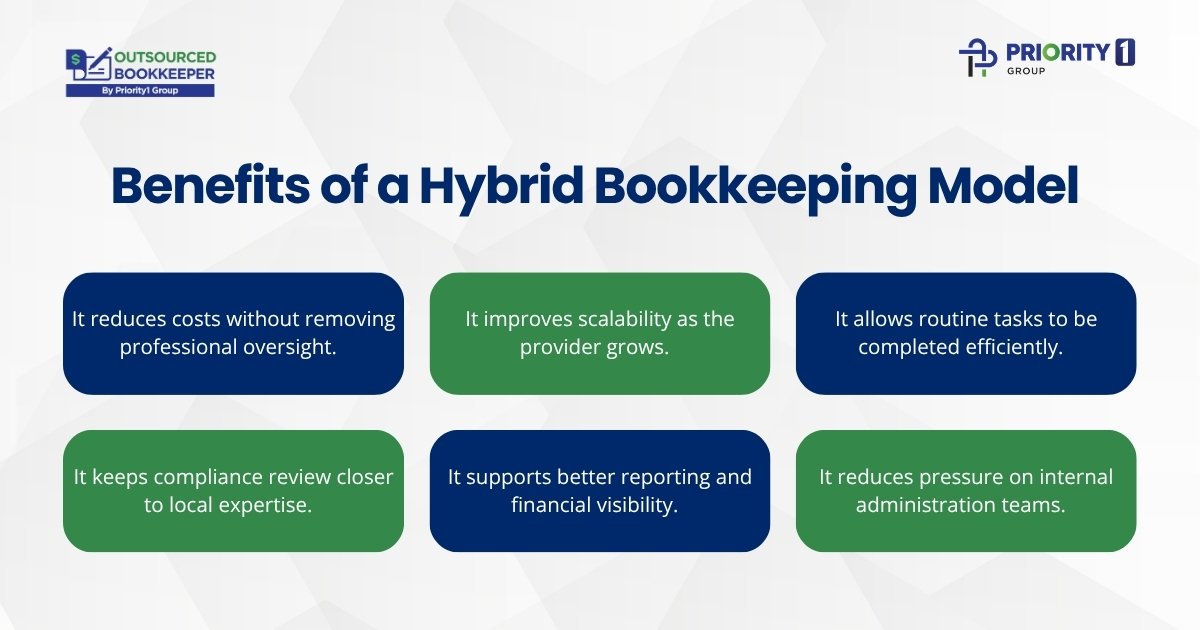
A hybrid bookkeeping model can support providers in several practical ways:
When managed properly, this model gives providers the flexibility to grow without losing control over financial accuracy.
Compliance is one of the biggest reasons bookkeeping cannot be treated as a basic admin task. NDIS providers must ensure that their financial records are accurate, transparent, and supported by proper documentation.
This includes correct invoicing, clear allocation of participant-related expenses, payroll accuracy, and timely reconciliations. In the centre of this process, NDIS Bookkeeping becomes important because sector-specific knowledge helps providers avoid errors that may affect claims, reporting, and audit readiness.
For more detail on financial requirements for NDIS organisations, you can read this guide: NDIS Accounting for Nonprofits: What You Need to Know
Modern bookkeeping is no longer limited by location. Cloud accounting platforms, secure document sharing, automation, and communication tools allow domestic and offshore teams to work together smoothly.
Technology helps maintain transparency. Business owners can review reports, approve payments, check reconciliations, and access documents without waiting for manual updates. This makes the hybrid model more reliable and practical for growing providers.
One of the most overlooked aspects of successful bookkeeping, especially in hybrid models, is process documentation. Without clearly defined workflows, even the best systems and teams can create inconsistencies.
Documented processes ensure that every task, from invoice entry to reconciliation and reporting, follows a standard method. This reduces dependency on individual team members and creates consistency across both domestic and offshore teams.
For NDIS providers, this is particularly important because compliance requires traceability. Having documented workflows makes audits smoother, reduces errors, and ensures that financial records are always supported by clear processes.
Choosing the right partner is important because the success of the model depends on systems, communication, and accountability.
A reliable provider should offer:
Working with the right outsourced bookkeeper helps providers create a bookkeeping structure that is both cost-effective and dependable.
When adopting a hybrid bookkeeping model, many providers initially worry about data security and control. However, modern systems are designed with strong security frameworks, including encrypted access, role-based permissions, and secure cloud storage.
The key is not where the work is done, but how it is managed. With proper access controls, audit trails, and secure platforms, businesses can maintain full visibility and control over their financial data.
For NDIS providers handling sensitive participant and financial information, ensuring data protection is critical. A well-managed hybrid model actually strengthens security by introducing structured access, accountability, and monitoring across all financial processes.
The demand for flexible bookkeeping support is increasing across Australia. Businesses want accurate financial management, but they also want solutions that are practical, scalable, and affordable.
For providers managing tight margins and growing operational demands, outsourced bookkeeping Australia is becoming a preferred option because it combines professional support with greater flexibility. This is particularly useful for NDIS providers who need accurate financial systems without increasing internal overheads.
The choice between domestic and offshore bookkeeping does not need to be a strict decision. For many NDIS providers, the best solution is a balanced model that combines local knowledge with offshore efficiency.
A hybrid bookkeeping approach helps reduce costs, improve accuracy, support compliance, and create stronger financial visibility. It gives providers the structure they need to grow while keeping financial management organised and reliable.
Partnering with a professional Outsourced Bookkeeper by Priority1 Group ensures accurate financial management and supports NDIS providers in maintaining compliance, growing their business, and providing high-quality care to participants.