
As NDIS providers grow, financial management becomes more complex and strategic. What starts as basic bookkeeping soon evolves into a need for deeper financial insights, planning, and control. This is where many businesses begin to explore options like fractional CFOs and outsourced bookkeepers.
However, there is often confusion around what each role actually does. While both support financial management, they serve very different purposes. Understanding the difference is essential for making the right decision for your organisation.
For NDIS providers especially, choosing the right financial support structure can directly impact compliance, cash flow, and the ability to deliver consistent, high-quality care.
An outsourced bookkeeper focuses on the day-to-day financial operations of a business. This includes recording transactions, reconciling accounts, managing payroll data, and ensuring financial records are accurate and up to date.
Bookkeepers form the foundation of financial management. Without accurate records, it becomes difficult to generate reliable reports or make informed decisions.
For growing organisations, outsourced bookkeeping is often preferred over hiring internally because it offers flexibility, consistency, and access to structured processes without the burden of recruitment or training.
A fractional CFO operates at a higher strategic level. Instead of focusing on daily financial tasks, they provide guidance on financial planning, forecasting, budgeting, and long-term growth strategies.
They are typically engaged on a part-time basis and work closely with business owners to improve profitability, manage risk, and support major financial decisions.
While a bookkeeper ensures your numbers are correct, a fractional CFO helps interpret those numbers and guide business direction
Understanding the distinction between these roles helps clarify when each is needed:
Both roles are important, but they are not interchangeable.
For NDIS providers, the priority is usually maintaining accurate and compliant financial records. This includes managing participant billing, payroll, expenses, and reporting.
Without strong bookkeeping systems, higher-level financial planning becomes ineffective. A fractional CFO can only provide meaningful insights if the underlying data is accurate and reliable.
This is why most providers begin by strengthening their bookkeeping processes before considering strategic financial roles.
Outsourcing has become a practical solution for managing bookkeeping efficiently. Instead of relying solely on internal staff, businesses can access skilled professionals who use structured systems and processes.
With offshore bookkeeping, organisations can manage routine financial tasks cost-effectively while maintaining consistent workflows. This approach reduces internal workload and improves turnaround times.
For many providers, outsourcing also eliminates the stress of hiring, training, and managing in-house staff, allowing them to focus on core operations.
Outsourced bookkeeping offers several advantages, particularly for growing NDIS providers:
To explore how outsourcing supports growth without increasing internal pressure, you can read:
How Outsourced Bookkeeping Helps You Scale Without Hiring Stress
A fractional CFO becomes valuable when the business reaches a stage where strategic financial decisions are required. This typically happens when revenue grows, operations expand, or financial complexity increases.
At this stage, businesses need support with forecasting, budgeting, cost management, and financial planning. A CFO helps align financial strategies with business goals and identifies opportunities for growth.
However, without strong bookkeeping systems in place, the impact of a CFO is limited.
Rather than choosing between a bookkeeper and a CFO, many businesses benefit from using both roles together.
The bookkeeper ensures that all financial data is accurate and organised. The CFO then uses this data to provide insights, identify trends, and guide decision-making.
This combination creates a complete financial system where both operational accuracy and strategic direction are covered.
The modern approach to financial management often combines outsourced bookkeeping with part-time CFO support. This hybrid model allows businesses to maintain strong financial systems while also accessing strategic expertise when needed.
Through offshore bookkeeping services, routine financial tasks can be handled efficiently, freeing up resources for higher-level planning and decision-making.
This model is particularly useful for NDIS providers who need both compliance-focused bookkeeping and strategic financial oversight.
In the NDIS sector, financial accuracy is not just about numbers, it directly impacts participant outcomes, funding utilisation, and compliance reporting.
Errors in bookkeeping can lead to incorrect claims, payroll issues, and reporting discrepancies. This is why structured financial systems are essential.
In the centre of this framework, services like NDIS Bookkeeping ensure that financial processes align with industry requirements and standards.
For a deeper understanding of how financial planning aligns with service delivery, you can explore:
Aligning Your NDIS Budget with Service Goals
Selecting the right financial support depends on the stage and needs of your business.
If your focus is on improving accuracy, managing daily transactions, and ensuring compliance, outsourced bookkeeping is the right starting point. It builds a strong financial foundation that supports future growth.
If your business is expanding and requires financial strategy, forecasting, and performance analysis, a fractional CFO can add significant value.
In many cases, combining both roles creates the most effective solution.
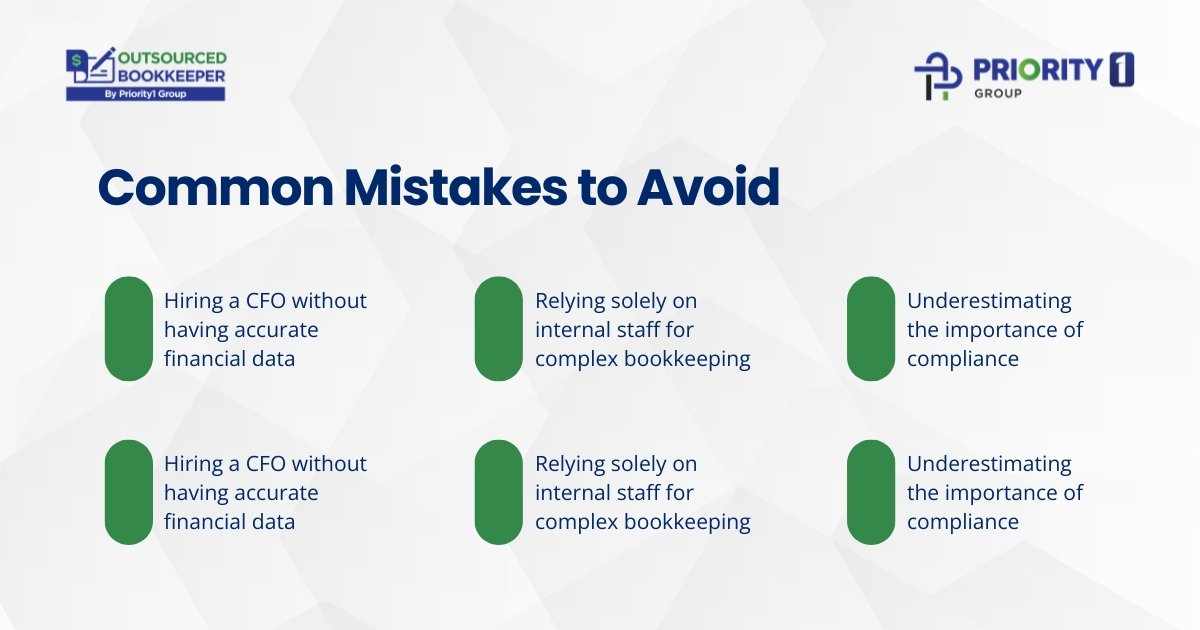
When deciding between these roles, businesses often make avoidable mistakes:
Avoiding these mistakes ensures that your financial management approach remains efficient and scalable.
The financial landscape for NDIS providers is evolving rapidly. Increased compliance requirements, growing operational complexity, and the need for real-time insights are driving changes in how businesses manage their finances.
Outsourcing, automation, and hybrid financial models are becoming standard practices. Businesses that adopt these approaches early are better positioned to scale, manage risks, and maintain strong financial control.
Understanding the difference between fractional CFOs and outsourced bookkeepers is essential for building a strong financial system. While both roles play important parts, they serve different purposes and should be used at the right stage of business growth.
Outsourced bookkeeping provides the foundation, ensuring accuracy, compliance, and consistency. Fractional CFOs add strategic value by guiding financial decisions and planning for growth.
For NDIS providers, starting with a strong bookkeeping system is the most practical and effective approach.
Partnering with a professional Outsourced Bookkeeper by Priority1 Group ensures accurate financial management and supports NDIS providers in maintaining compliance, growing their business, and providing high-quality care to participants.