
Many business owners focus on improving sales, customer service, and team performance when looking for ways to grow. While these areas are important, there is another factor that often determines how smoothly a business operates: its financial workflows.
Behind every successful business are processes that keep invoices moving, suppliers paid, payroll managed, expenses tracked, and reports delivered on time. When these systems work well, operations tend to run efficiently. When they do not, businesses often experience delays, confusion, duplicated effort, and unnecessary administrative pressure.
As businesses grow, managing financial tasks becomes increasingly complex. More customers, more employees, and higher transaction volumes place greater demands on internal systems. Without structured financial workflows, small inefficiencies can quickly develop into larger operational challenges.
This is why many organisations are now reviewing the way financial processes support daily operations. Streamlined bookkeeping systems help reduce bottlenecks, improve productivity, and create stronger foundations for sustainable business growth.
Financial processes influence far more than accounting. They affect how quickly decisions are made, how efficiently teams operate, and how smoothly information moves throughout an organisation.
From processing invoices to managing payroll, financial workflows connect multiple departments and play a critical role in operational efficiency.
Businesses rely on financial workflows for:
When these processes operate efficiently, teams spend less time searching for information and more time focusing on productive work.
However, when workflows become disorganised, delays often occur across multiple areas of the business. Managers may wait for approvals, staff may struggle to locate documents, and reporting may become inconsistent.
The result is reduced productivity and increased operational frustration.
Many businesses recognise direct financial costs but underestimate the impact of operational inefficiencies.
A delayed invoice, missing receipt, duplicated data entry task, or approval bottleneck may appear minor in isolation. However, when these issues occur repeatedly, they consume valuable time and resources.
Common signs of inefficient financial workflows include:
These inefficiencies not only increase administrative workload but also reduce the time available for customer service, business development, and strategic planning.
Businesses that actively improve workflow efficiency often discover opportunities to increase productivity without increasing staffing costs.
The way businesses operate has changed significantly over the past decade. Digital platforms, hybrid workplaces, cloud software, and increasing compliance requirements have transformed operational expectations.
As a result, many organisations are now reviewing internal systems to identify opportunities for improvement.
Business leaders are increasingly focused on:
Financial workflows often become a key focus during these reviews because they influence so many operational areas.
Businesses that create efficient financial processes generally experience fewer disruptions, faster decision-making, and greater operational consistency.
Bookkeeping is often viewed purely as a financial function, but its impact extends throughout the entire organisation.
Well-organised bookkeeping systems create consistency by ensuring financial information is recorded accurately, updated regularly, and available when required.
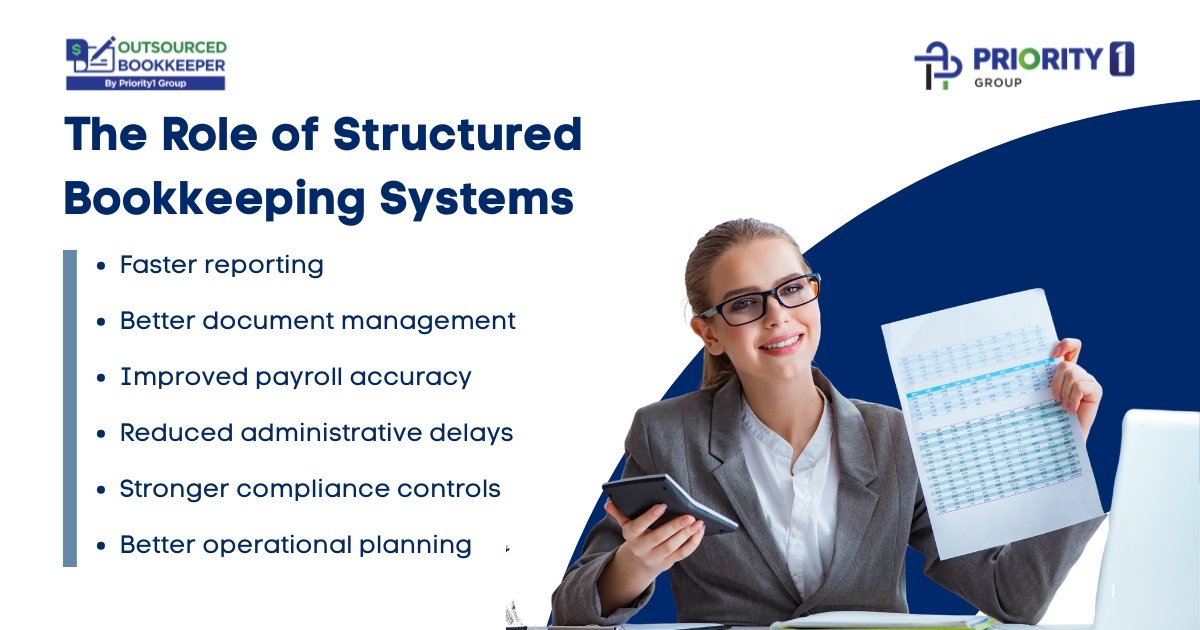
Businesses with structured bookkeeping processes often benefit from:
These improvements help reduce friction across the business and support smoother day-to-day operations.
This is one reason many organisations are turning to bookkeeping outsourcing services to strengthen financial processes while improving overall efficiency.
As businesses grow, internal teams often become responsible for multiple administrative functions. Bookkeeping tasks may be spread across managers, administrators, and finance staff, creating inconsistencies and reducing efficiency.
Outsourcing provides access to dedicated expertise while allowing internal teams to focus on higher-value activities.
Businesses often experience benefits such as:
Businesses considering whether to manage bookkeeping internally or seek external support should evaluate both the financial and operational impact of each approach. Understanding the true costs associated with different models can help organisations make informed decisions about future growth and efficiency. For further insight, read this article on outsourced bookkeeping versus in-house bookkeeping and the real cost breakdown.
Many industries rely heavily on efficient financial processes to maintain operational consistency.
Healthcare providers, hospitality businesses, construction companies, retailers, and disability service providers all manage large volumes of financial information alongside daily operational responsibilities.
Within the disability sector, providers commonly manage:
Maintaining consistency across these activities requires strong systems and a clear understanding of industry obligations.
This is why many providers choose specialised support such as NDIS Bookkeeper services that understand the financial and operational complexities associated with disability services.
For disability providers, strong financial systems depend not only on processes but also on staff understanding. Teams that understand documentation requirements, financial responsibilities, and compliance obligations are often better equipped to support operational consistency. This guide on training your team on NDIS financial management highlights the importance of financial awareness across the organisation.
Technology has significantly improved the way businesses manage financial information.
Cloud accounting platforms, automation tools, digital approval systems, and remote bookkeeping services have reduced many of the manual tasks that previously consumed significant time and resources.
Modern financial systems now support:
Businesses can now access professional bookkeeping support regardless of location while maintaining visibility over financial processes and operational performance.
While technology improves efficiency, successful implementation still depends on strong processes and experienced professionals who understand operational workflows.
The most effective businesses combine technology with structured financial management to create sustainable operational improvements.
Many organisations focus heavily on increasing revenue when pursuing growth. However, improving internal efficiency can often deliver equally valuable results.
Better financial workflows help businesses:
When employees spend less time resolving administrative issues, they can focus more on customer service, innovation, and business development.
This creates stronger operational foundations and allows businesses to grow more efficiently over time.
Efficient businesses are built on efficient systems. While financial workflows often operate behind the scenes, they influence nearly every aspect of daily operations.
Structured bookkeeping processes help businesses reduce administrative burden, improve reporting accuracy, strengthen communication, and create smoother operational workflows. As organisations continue to grow, these efficiencies become increasingly valuable.
For businesses looking to improve operational performance while maintaining strong financial systems, Outsourced Bookkeeper by Priority1 Group provides tailored bookkeeping support designed to streamline workflows, improve efficiency, and support long-term business success.