
Technology has changed almost every aspect of business operations, and bookkeeping is no exception. What was once a highly manual process involving spreadsheets, paper records, and time-consuming reconciliations has evolved into a more connected, automated, and data-driven function.
Today’s businesses operate in a fast-moving environment where access to accurate financial information can influence decision-making, operational planning, and long-term growth. Business owners no longer want to wait until the end of the month to understand how their finances are performing. They expect real-time visibility, faster reporting, and more efficient financial processes.
As accounting software continues to evolve, businesses are discovering new ways to simplify financial management, reduce administrative burden, and improve accuracy. However, technology alone is not enough. The greatest benefits occur when businesses combine digital tools with structured financial processes and experienced bookkeeping support.
This shift is changing the way organisations approach bookkeeping and creating new opportunities for businesses to operate more efficiently.
Traditional bookkeeping relied heavily on manual processes. Financial records were often maintained across spreadsheets, paper files, and disconnected systems, making reporting and reconciliation time-consuming.
Modern bookkeeping systems now provide:
These developments have reduced many repetitive administrative tasks and improved access to financial information.
Instead of spending hours entering data manually, businesses can now focus more on analysing information and making informed decisions.
Technology has transformed bookkeeping from a record-keeping function into a valuable business management tool.
Cloud accounting platforms have become one of the biggest drivers of change within the bookkeeping industry.
Unlike traditional desktop software, cloud systems allow authorised users to access financial information from anywhere with an internet connection. This accessibility improves collaboration between business owners, managers, accountants, and bookkeepers.
Businesses benefit from:
Cloud accounting platforms such as Xero, MYOB, and QuickBooks have become central components of modern financial management systems.
The ability to access financial information in real time allows businesses to respond more quickly to challenges and opportunities as they arise.
Automation is reducing many of the repetitive tasks that traditionally consumed significant amounts of bookkeeping time.
Processes that can now be partially or fully automated include:
Automation helps improve efficiency by reducing manual data entry and minimising the risk of human error.
However, automation does not eliminate the need for professional oversight. Businesses still require experienced professionals who understand financial reporting, compliance obligations, and bookkeeping best practices.
The goal of automation is not to replace expertise but to allow professionals to focus on higher-value activities.
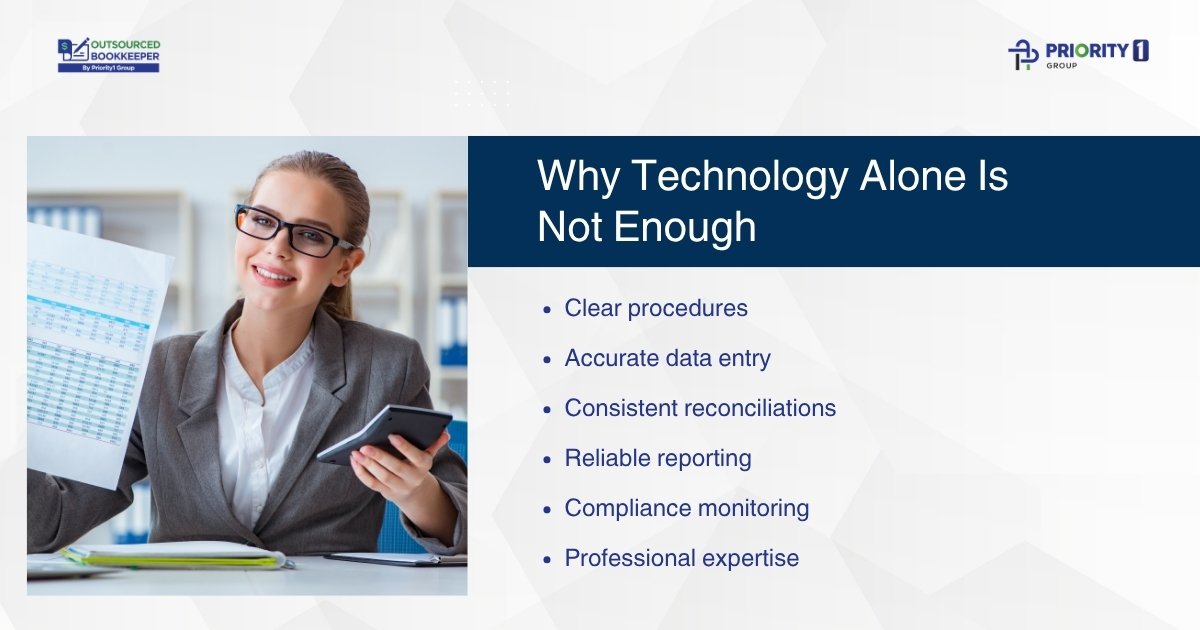
Many businesses assume that implementing new software will automatically solve their financial management challenges. Technology is only one part of the solution.
Without structured processes, clear workflows, and ongoing oversight, businesses can still experience reporting inaccuracies, compliance issues, and operational inefficiencies.
Successful financial management requires:
Technology performs best when supported by strong financial disciplines.
Businesses that combine digital tools with experienced bookkeeping support often achieve the best outcomes because they benefit from both efficiency and accuracy.
One of the biggest advantages of modern bookkeeping technology is improved decision-making.
Business owners no longer need to rely solely on historical reports. Real-time information allows management teams to monitor financial performance continuously and respond more quickly to changing circumstances.
Technology can provide visibility into:
This information helps businesses make more informed decisions regarding staffing, investment, budgeting, and growth strategies.
The ability to access timely financial information has become a competitive advantage for many organisations.
Technology has also changed the way businesses access bookkeeping support.
Rather than relying solely on internal finance teams, many organisations now use flexible bookkeeping models that combine technology with professional expertise.
Businesses evaluating different bookkeeping approaches should consider factors such as cost, scalability, operational requirements, and internal resources.
For businesses comparing different approaches, our article In-House vs Outsourced Bookkeeping: Which Is Right for Your Stage? provides valuable insight into how bookkeeping structures can influence efficiency, flexibility, and business growth.
This evaluation becomes increasingly important as businesses grow and financial management requirements become more complex.
Technology is also creating significant improvements within disability service organisations.
NDIS providers often manage complex financial processes involving participant funding, invoicing, payroll, compliance requirements, and service delivery reporting.
Providers commonly manage:
Managing these responsibilities efficiently requires both strong systems and specialised industry knowledge.
This is why many providers rely on specialised support such as NDIS Bookkeeper services that understand the unique operational and financial requirements associated with disability services.
Financial strategy remains equally important alongside technology adoption. Providers looking to strengthen long-term sustainability can benefit from reading Creating Effective Financial Strategies for NDIS Success.
Technology supports efficiency, but strategic financial management continues to play a critical role in organisational success.
The increasing availability of cloud technology has also contributed to the growth of external bookkeeping support models.
Businesses are increasingly seeking outsourced bookkeeping services Australia because these solutions provide access to expertise, technology, and scalable support without the need to build large internal finance teams.
Benefits often include:
These advantages make outsourcing an attractive option for organisations looking to improve efficiency while maintaining strong financial controls.
The bookkeeping industry will continue evolving as technology advances.
Artificial intelligence, predictive reporting, automated workflows, and integrated financial ecosystems are already influencing how businesses manage financial information.
Future developments are likely to focus on:
Businesses that embrace these changes early will be better positioned to improve efficiency and adapt to future challenges.
This is one reason many organisations are exploring outsource bookkeeping solutions that combine technology, expertise, and flexible support structures.
Technology has transformed bookkeeping from a largely administrative function into a strategic business tool. Cloud accounting systems, automation, and digital workflows are helping businesses improve efficiency, reduce manual workloads, and gain faster access to financial information.
However, technology alone does not guarantee success. Businesses still require strong processes, professional expertise, and reliable financial oversight to achieve the best outcomes.
As financial management continues to evolve, organisations that successfully combine technology with structured bookkeeping practices will be better positioned to improve operational performance and support long-term growth.
For businesses seeking to modernise financial processes while maintaining accuracy and compliance, Outsourced Bookkeeper by Priority1 Group provides tailored bookkeeping support designed to help organisations take advantage of modern technology while building stronger financial foundations.